I grew up watching Rajasthani women. My grandmothers, my aunts, my mother. Women who lived within patriarchy and scarcity, yet carried an unmistakable strength. With fewer resources and fewer choices, they still built independence, quietly and stubbornly claiming their space without asking permission.
My grandmother raised five children while running a small business from home. My mother chose to return to education and step into the workforce after two children, at a time when most women around her did not. Their lives taught me something early on: women are already empowered. They just need an enabling environment.
Years later, as I work across rural Rajasthan, I see that same strength in the women of Sambhar. This time on farms, in self- help group meetings, and in the decisions, women are finally able to make about land, water, and livelihoods.
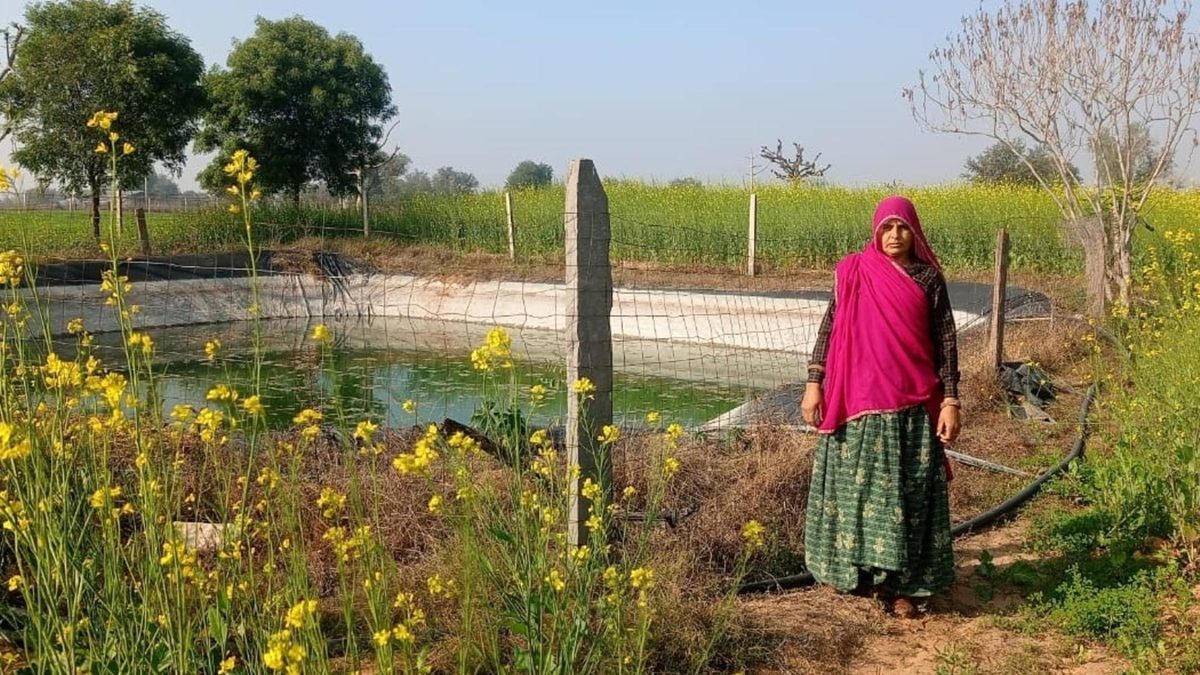
I see it clearly in Mohari Devi. She lives in Sursingpura village of Sambhar block, a region facing acute water stress. Groundwater is over-exploited in most blocks of Rajasthan, with Sambhar among the most critically affected. High water salinity and declining water tables have made agriculture increasingly difficult.
Mohri Devi is a farmer and a mother of three. Until a few years ago, farming for her family was deeply uncertain. She and her husband cultivated two hectares of rainfed land, dependent entirely on the monsoon. When rains failed or arrived late, the fields remained empty. During the dry months, the family relied on daily wage labour. They lived in a “kutcha” house, and farming was about getting through the year, not planning beyond it.
Climate change was not a phrase used in the village, but its effects were visible. Falling water levels, exhausted soil, heat stress, rising input costs, and harvests that barely cover expenses.
Mohari Devi’s journey began to shift when she joined her village’s Self-Help Group. Initially, it was simply a space to talk, to sit with other women and name shared challenges. Conversations ranged from water scarcity and poor soil quality to high fertiliser costs, low produce, and a deeper sense of helplessness caused by lack of knowledge and agency.
With quiet determination, Mohari Devi, who once rarely spoke in front of others or travelled alone outside her village, chose to enroll in agricultural training supported by Royal Rajasthan Foundation. In spaces where decisions were usually made by her husband, she stepped forward to learn new farming practices. Training in vermicomposting and crop planning helped reduce chemical inputs, lower costs, and restore soil health.
The most transformative change came with water.
With new knowledge, confidence, and support from RRF, Mohari was able to access a farm pond through the “Khet Talai Nirman Karyakram”, a government scheme enabling farmers to construct a farm pond. Having water available through the year changed everything. For the first time, Mohari cultivated a rabi crop (second crop of the year). That year, she grew wheat and barley and made a handsome profit. It marked a shift from survival to planning.
With increased income, her family constructed a “pucca” 2-room house. She developed a kitchen garden for household nutrition, increased her livestock, and invested in a sprinkler system to use water more efficiently and purchased a tractor. She also ensured that her daughter could pursue higher education. Today, Mohari Devi decides what happens on her land. She plans cropping cycles, manages resources, and participates actively in collective decision making. She feels confident enough to plan for a future.
Through my work at Royal Rajasthan Foundation, I see this transformation repeated across villages. Women like Mohari Devi do not surprise me because they are exceptional. They remind me of what has always existed. Strength waiting for opportunity. In many ways, life has come full circle. I grew up watching women quietly push boundaries inside their homes. Today, I work alongside women who are doing the same, shaping their own futures.
Sharvari Patwa heads the Royal Rajasthan Foundation, which advances women’s agency through water security, climate-smart agriculture, and clean energy access to build climate-resilient livelihoods in rural Rajasthan.
